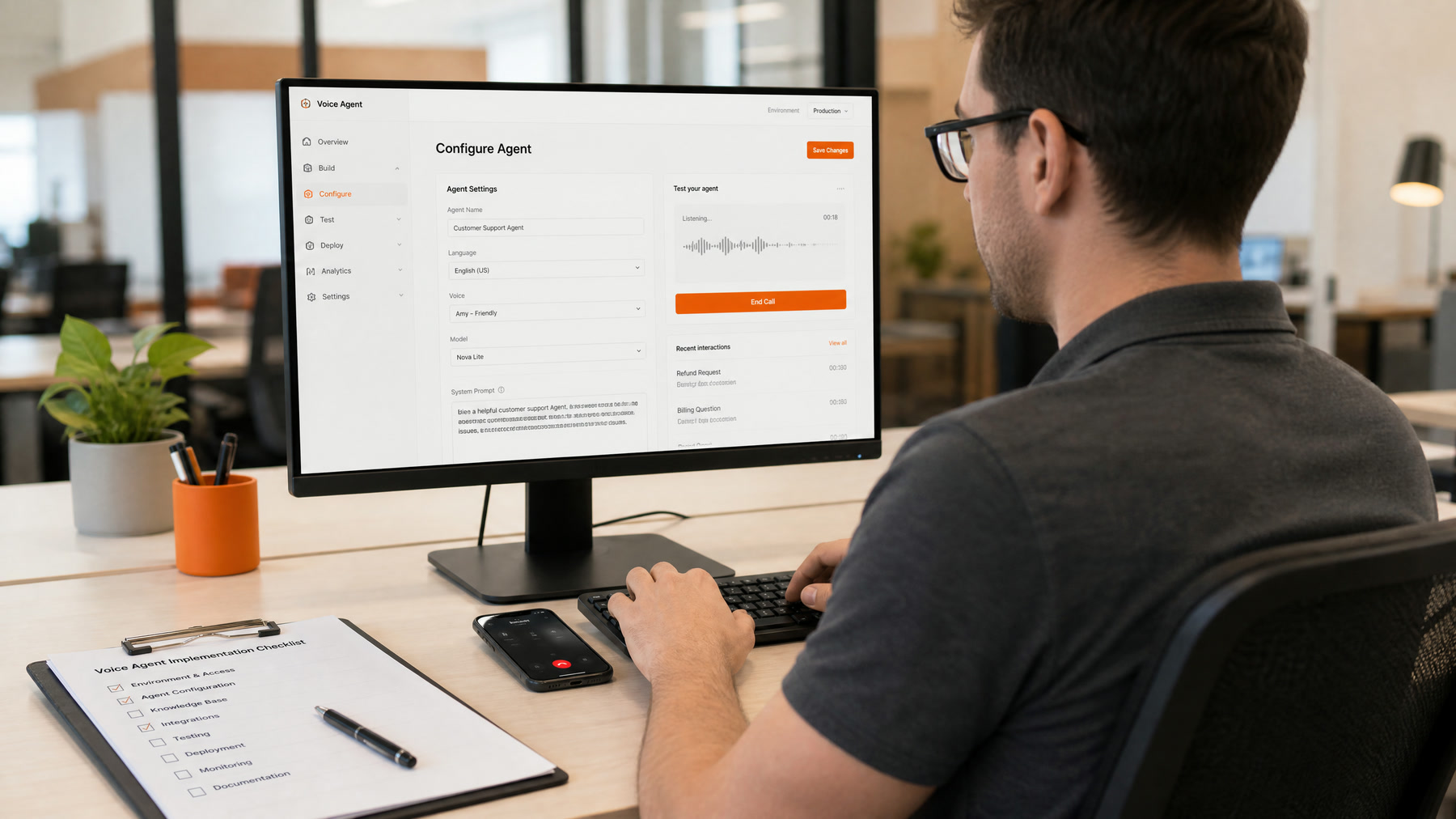
Treat It Like a New Front-Line Process
An AI voice agent is not a widget you switch on. It is a new front-line process that talks to your customers. Like any new hire, it needs a defined job, approved information, access to the right systems, rules for exceptions, and regular review.
This is the implementation process we follow. Most projects with integrations take four to eight weeks from kickoff to a stable launch; simpler agents can go live in one to two weeks.
Phase 1: Discovery
Goal: pick the right first job and agree on how success will be measured.
- Pull a month of call logs and, if available, recordings
- Group calls by reason, volume, value, and time of day
- Choose one narrow job, such as after-hours booking, missed-call callbacks, or new lead qualification
- Record a baseline: answer rate, bookings, response times, and staff time on the phone
Our AI automation readiness audit helps structure this.
Phase 2: Conversation Design
Goal: write down exactly what the agent does.
- The greeting, AI disclosure, and recording notice
- The questions it asks and in what order
- Approved answers to common questions
- Actions it may take, such as booking or creating a ticket
- Transfer rules and emergency handling
- Phrases and topics it must avoid
Use our script templates and call flow examples as starting points.
Phase 3: Platform and Integrations
Goal: connect the agent to the systems that turn calls into outcomes.
- Choose a platform; see how to choose an AI calling platform
- Connect your calendar, CRM, field service or practice software in a test environment
- Validate every write: correct record, correct fields, no duplicates
- Decide what happens when a system is unavailable mid-call
- Set up phone routing: overflow, after-hours, or AI-first
Phase 4: Testing
Goal: find the failures before customers do.
Build at least 20 test scenarios, including:
- Silence and long pauses
- Interruptions and corrections
- Ambiguous requests
- Unavailable time slots
- Wrong numbers and spam
- Urgent or emergency callers
- Requests for a person
- Integration failures
Run them all, fix the failures, then run them again. Include staff in test calls; they know the edge cases best.
Phase 5: Controlled Launch
Goal: go live with limited risk.
- Start with a limited scope, such as after-hours calls or overflow only
- Monitor live during the first days
- Review every transcript in the first week
- Keep a one-step way to switch the agent off and route calls to staff
Phase 6: Review and Improve
Goal: turn real calls into a better agent.
- Review transcripts and outcomes weekly for the first month
- Track completion, transfers and reasons, early hang-ups, and corrections
- Turn each recurring issue into a script, rule, or integration fix
- Expand to new call types only when the current ones are stable
Our article on the first 30 days after launch shows what this looks like week by week.
Guardrails to Build In From the Start
- Clear AI disclosure; never pretend to be a person
- Recording notices where required
- Fast, warm transfers to people, with a fallback when nobody answers
- Identity verification before discussing accounts
- No autonomous changes when a connected system is down or returns unexpected data
- Logs of every action the agent takes
See voice AI compliance and handoff and the security checklist.
Roles You Need
- Owner: a person accountable for results and decisions
- Process expert: someone who knows how calls should be handled today
- Builder: the internal team or partner configuring and integrating the agent
- Reviewer: someone who reads transcripts and flags issues each week
In small businesses, one person may wear several hats, but each role must be covered.
How to Measure Success
- Call completion or containment rate
- Booking, qualification, or routing accuracy
- Transfer success and how often callers repeat themselves
- Early hang-ups
- Revenue or time saved against the baseline
See voice AI KPIs for formulas.
Bottom Line
Successful voice AI implementations start narrow, design the conversation carefully, connect real systems, test hard, launch with controls, and improve from real calls. Follow the implementation checklist, or let us run the process with you through our AI voice agent services.