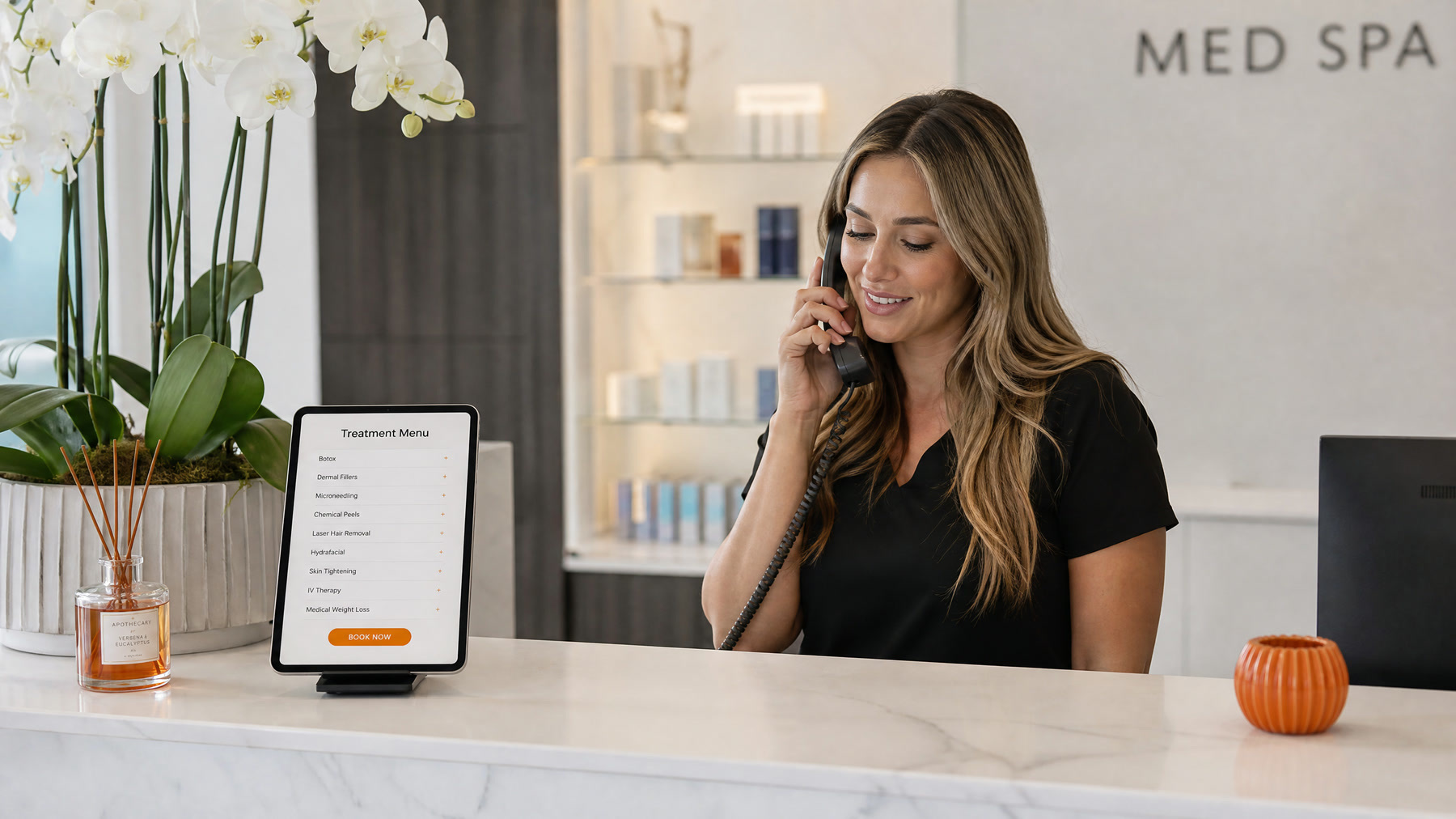
Why Med Spas Lose Bookings on the Phone
Med spa treatments carry high ticket values, and the buying decision usually starts with a question the caller is slightly nervous to ask.
"How much is it?" "Does it hurt?" "How long is the downtime?" "Am I a candidate?"
When those calls go to voicemail, the caller does not leave a message. They go back to the search results and call the next clinic. The enquiry was warm, and it is gone.
Front desk staff at a busy clinic are checking in clients, handling payment, and prepping rooms. The phone is genuinely competing with the person standing in front of them, and the person in front usually wins.
What an AI Receptionist Handles
Consultation booking. Check real provider availability, book into the correct appointment type, and send a confirmation with prep instructions.
Treatment and pricing questions. Answer from your approved, current price list and treatment descriptions rather than a staff member's memory.
Pre and post care questions. Answer the routine ones from your approved aftercare documentation, and escalate anything that sounds clinical.
Rescheduling and cancellations. Handle them instantly and offer the freed slot to the waitlist.
Membership and package questions. Explain what is included and what it costs.
Lead reactivation. Call or message clients who have not booked in a defined window and offer a return appointment.
The Clinical Boundary Is Not Optional
This is the part med spas must get right, and it is not primarily a technology question.
An AI receptionist should never:
- Assess whether a specific person is a candidate for a treatment
- Give medical advice about a reaction, complication, or symptom
- Interpret photographs or described symptoms
- Discuss another client's treatment or records
- Make claims about outcomes for an individual
The correct behaviour for any clinical question is a short, clear handoff: acknowledge, do not speculate, route to a provider, and log it. Anything that sounds like a complication should escalate immediately and be flagged, not queued.
Write this boundary into the configuration explicitly and test it deliberately before launch. Call the agent and describe a reaction. If it offers reassurance rather than escalating, it is not ready.
Your regulatory obligations depend on where you operate and what you offer, so have whoever advises you on compliance review the call flows and the data handling before you go live.
Pricing Questions Deserve a Decision
Clinics split on whether to quote prices over the phone. Both positions are defensible, and you should choose deliberately rather than letting the agent improvise.
Quote openly. Faster qualification, fewer wasted consultations, and callers who book are already comfortable with the number. Works well when your pricing is straightforward and published.
Quote a range, then book. Gives a realistic bracket and moves to consultation for the specific plan. Works well when the price depends heavily on the treatment plan.
Decline to quote. Protects the consultation as the sales moment, but loses price-sensitive callers who will simply call a clinic that answers the question.
Whichever you choose, make the agent consistent. The worst outcome is a caller who gets a number on the phone and a different number at the consultation.
Lead Reactivation Is the Underused Play
Most med spas have a large list of clients who came once or twice and drifted. They are not unhappy. They simply got busy.
An outbound agent can work that list systematically: call or message clients past a defined interval, reference their last treatment category, and offer a booking. Anyone who engages gets booked or handed to a human.
This works because the list is warm, the contact is relevant, and the effort would otherwise never happen. Front desk staff rarely get a quiet hour to call two hundred lapsed clients.
Consent and contact rules apply, and they vary by jurisdiction. Confirm your list has a lawful basis for marketing contact and that opt-out is honoured immediately and permanently.
Reducing No-Shows
No-shows hurt disproportionately in aesthetics because the appointment blocks a provider and a room for a long slot.
A reminder sequence that actually reduces them:
- Confirmation immediately at booking with date, time, provider, prep instructions, and cancellation policy
- Reminder several days out with an easy one-tap reschedule option
- Reminder the day before with prep instructions repeated
- Immediate waitlist offer when a cancellation frees a slot
The reschedule option matters more than people expect. A client who can move the appointment in one tap will move it instead of silently not showing up, and you keep the booking.
What to Measure
- Consultation bookings by phone per week
- Percentage of calls answered, especially during clinic hours
- No-show rate before and after the reminder sequence
- Reactivation bookings from the dormant list
- Escalation rate and, specifically, whether clinical questions escalated correctly
- Revenue per booked consultation
The escalation audit is the one not to skip. Review every escalated call for the first month and confirm the boundary held.
Final Recommendation
Start with consultation booking and after-hours answering, because that is where warm enquiries are being lost today.
Set the clinical boundary explicitly, decide your pricing policy deliberately, test the escalation path with realistic clinical questions before launch, and add lead reactivation once the inbound flow is proven.