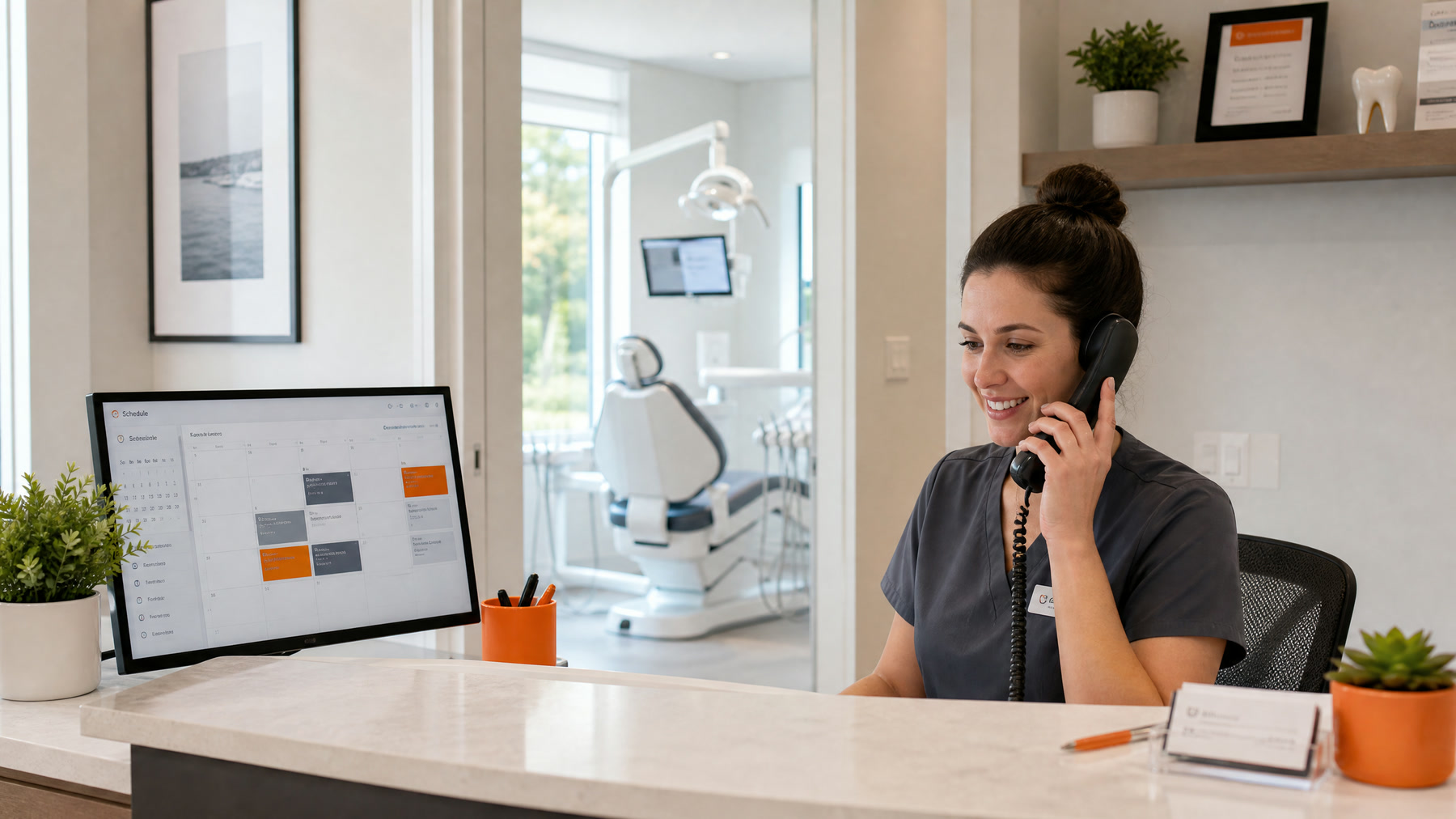
Why calls matter for dental practices
The phone is still how most patients book a dental visit, and it rings hardest when the front desk is busiest: during check-in, checkout, and insurance calls. New-patient callers who reach voicemail rarely leave a message; they call the next practice on the list. After hours, a patient with a broken tooth or swelling wants to know whether they can be seen tomorrow.
An AI receptionist answers every call, books new-patient and hygiene appointments into your real availability, separates true emergencies from routine questions, and gives your team a clean summary with insurance details collected before the visit. Recall and reactivation calls can run in the background without pulling anyone off the desk.
Common call types
Automations
Benefits
What a call sounds like
An illustrative example of a typical call. Your receptionist follows your own rules, services, and wording.
What the AI receptionist asks
Urgent calls go straight to a person
Swelling that affects breathing or swallowing, or bleeding that will not stop
The receptionist tells the caller to call 911 or go to the nearest emergency room, then notifies your on-call dentist. It does not give clinical advice.
A knocked-out adult tooth
Treated as the most time-sensitive dental call. The receptionist reads the first-aid steps your dentist has approved and connects the caller to the on-call dentist right away.
Severe pain, a broken tooth, or a lost filling or crown
Offered the earliest urgent slot. After hours, the call goes to your on-call dentist if you have one, or the patient is booked first thing in the morning.
Problems after a procedure, such as bleeding after an extraction
Transferred to the treating dentist or the on-call line, with the procedure date and symptoms noted.
Works with your software
We connect through each vendor's API, webhooks, or a workflow tool. What is possible depends on your plan and the vendor's API access, which we confirm before quoting.
What to get right
Implementation plan
Write your new-patient, emergency, and recall rules with your office manager.
Connect your practice management software or calendar and test real bookings.
Set up texts for forms, insurance cards, and confirmations.
Launch on after-hours and overflow calls, then review transcripts weekly.
AI receptionist or a live answering service?
An answering service can take down that a patient has a toothache, but it cannot see your schedule, so the patient still waits for a callback. An AI receptionist offers the next open visit during the call, and it follows your emergency rules for swelling, heavy bleeding, or a knocked-out tooth, including alerting your on-call dentist.
A live answering service
- Operators answer from a script and take a message for you to return.
- Booking into your calendar is rare and usually costs extra.
- Callers can wait when operators are busy with other clients.
- Billed by the minute or by the call, so busy months cost more.
- Better for upset callers and one-off situations that need judgement.
An AI receptionist
- Answers from your own services, prices, service area, and rules.
- Books the appointment, sends the confirmation, and updates your records during the call.
- Answers every call at once, at any hour.
- A one-time build plus usage, quoted before work starts.
- Hands urgent or unusual calls to a person, with the details gathered so far.
More detail: AI receptionist vs answering service and the published prices of eight services.
What it costs
Focused automations such as missed-call recovery typically cost $2,000 to $5,000 to build. A production AI receptionist with booking, CRM updates, and call transfers typically costs $5,000 to $15,000, plus monthly usage for calls and texts. Every quote is fixed-scope and in US dollars. See pricing details.
FREE CALL-FLOW REVIEWRelated services
FAQs
Can an AI receptionist handle dental emergency calls?
It recognizes urgent symptoms, follows the triage rules your dentist approves, offers the earliest urgent slot, and transfers true emergencies to your on-call dentist. It does not give clinical advice.
Does it work with Dentrix, Eaglesoft, or Open Dental?
We connect through your software's API, an approved integration partner, or a workflow tool. Access differs by product and plan, so we confirm what is possible before quoting.
Is an AI dental receptionist HIPAA compliant?
It can be. We build with a signed business associate agreement, encrypted call data, access controls, and only the patient details each call needs. Compliance also depends on your own policies, so we review the call flow with you.
Can it book new patients and collect insurance details?
Yes. It books into open new-patient slots, asks for the insurance carrier and policyholder, and texts a secure link for the insurance card and forms.
Can it run recall and reactivation campaigns?
Yes. It can call or text patients who are overdue for hygiene, offer open times, and log each outcome, following your consent and opt-out rules.
Will patients know they are talking to AI?
Yes. We recommend the receptionist introduces itself as a virtual assistant, and patients can ask for a person at any time during office hours.
Related guides
Voice AI for Dental Practices: New Patient Booking, Emergency Calls, and Recall
HEALTHCARE AIHIPAA-Compliant AI Receptionists: A Checklist for US Practices
APPOINTMENT AUTOMATIONHow to Reduce No-Shows With AI Appointment Reminders
AI VOICE AGENTSMissed-Call Automation: The Revenue Leak Most Local Businesses Ignore
AI VOICE AGENTSVoice AI Scripts for Appointment Booking and Lead Qualification
Sources
General information, not legal advice.
- Business Associates (U.S. Department of Health and Human Services)
- Leaving Messages for Patients (HIPAA FAQ 198) (U.S. Department of Health and Human Services)