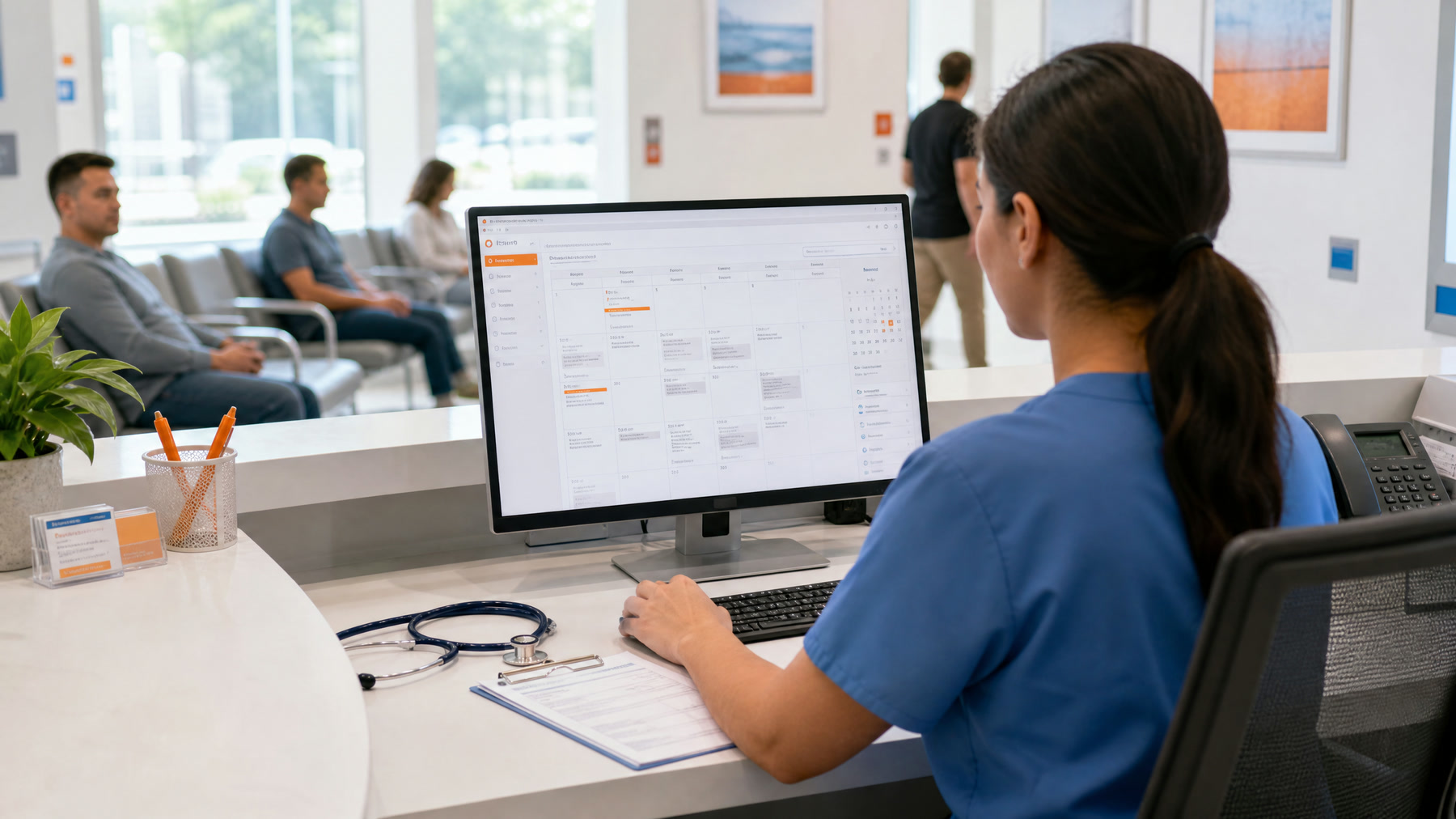
Why calls matter for healthcare clinics
Clinic phones carry a steady load of routine calls: booking, rescheduling, directions, forms, and what to bring. Each one takes a staff member away from the patient in front of them, and when lines are busy, patients wait on hold or leave voicemails that someone has to return later. Some callers, though, are describing symptoms that need a nurse or a doctor now.
An AI receptionist answers routine calls instantly, books and reschedules into your real schedule, and sends clinical questions and urgent symptoms to the right person every time. Your team gets a short summary of each call instead of a voicemail to decode.
Common call types
Automations
Benefits
What a call sounds like
An illustrative example of a typical call. Your receptionist follows your own rules, services, and wording.
What the AI receptionist asks
Urgent calls go straight to a person
Chest pain, trouble breathing, stroke symptoms, or severe bleeding
The receptionist tells the caller to hang up and call 911 right away. It does not try to book an appointment.
Thoughts of suicide or self-harm
The caller is given the 988 Suicide & Crisis Lifeline (call or text 988) and, during clinic hours, transferred to a clinician. Anyone in immediate danger is told to call 911.
New or worsening symptoms
Routed to your nurse line or triage queue with the symptoms recorded in the caller's own words. The receptionist does not judge severity beyond the red-flag list your clinicians write.
Lab results and medication questions
Taken as a message for clinical staff with a callback time. The receptionist never interprets results or gives dosing advice.
Works with your software
We connect through each vendor's API, webhooks, or a workflow tool. What is possible depends on your plan and the vendor's API access, which we confirm before quoting.
What to get right
Implementation plan
List appointment types, providers, and booking rules.
Have clinicians write the urgent-symptom list and escalation paths.
Connect your EHR or scheduling system and test bookings end to end.
Launch on overflow and after-hours calls, then review transcripts weekly.
AI receptionist or a live answering service?
Medical answering services exist to pass after-hours messages to the provider on call, and that part still needs people and clinical judgement. Routine calls are different: an AI receptionist books, moves, and confirms visits at any hour, and it sends symptoms or anything clinical to your staff without giving advice.
A live answering service
- Operators answer from a script and take a message for you to return.
- Booking into your calendar is rare and usually costs extra.
- Callers can wait when operators are busy with other clients.
- Billed by the minute or by the call, so busy months cost more.
- Better for upset callers and one-off situations that need judgement.
An AI receptionist
- Answers from your own services, prices, service area, and rules.
- Books the appointment, sends the confirmation, and updates your records during the call.
- Answers every call at once, at any hour.
- A one-time build plus usage, quoted before work starts.
- Hands urgent or unusual calls to a person, with the details gathered so far.
More detail: AI receptionist vs answering service and the published prices of eight services.
What it costs
Focused automations such as missed-call recovery typically cost $2,000 to $5,000 to build. A production AI receptionist with booking, CRM updates, and call transfers typically costs $5,000 to $15,000, plus monthly usage for calls and texts. Every quote is fixed-scope and in US dollars. See pricing details.
FREE CALL-FLOW REVIEWRelated services
FAQs
Can an AI receptionist give medical advice?
No. It avoids diagnosis and clinical advice, follows the escalation rules your clinicians write, and routes clinical questions to staff.
Does it work with athenahealth, eClinicalWorks, or Epic?
We connect through the EHR's API, an approved integration partner, or a workflow tool. Access depends on your EHR, version, and contract, so we confirm what is possible before quoting.
Is an AI medical receptionist HIPAA compliant?
It can be. Look for a signed business associate agreement, encryption, access controls, and audit logs, and limit what the receptionist collects to what each call needs.
Can it handle after-hours calls?
Yes. It can book and reschedule, answer common questions, and route urgent calls to your on-call provider or answering protocol.
Can it take prescription refill requests?
It collects the medication name, pharmacy, and callback number and sends the request to your clinical team. It never approves refills.
Can it answer calls in Spanish?
Yes. English and Spanish call flows are available, with a handoff to staff or an interpreter when needed.
Related guides
Voice AI for Healthcare Clinics: Appointment Scheduling Without Phone Chaos
HEALTHCARE AIHIPAA-Compliant AI Receptionists: A Checklist for US Practices
INDUSTRY AIAI for Healthcare Administration: Safer Ways to Start
APPOINTMENT AUTOMATIONHow to Reduce No-Shows With AI Appointment Reminders
INDUSTRY AIBilingual AI Receptionist: Serving Spanish-Speaking Customers Without Hiring
INDUSTRY AIAI Receptionist for Chiropractors: Book More New Patients
Sources
General information, not legal advice.
- Covered Entities and Business Associates (U.S. Department of Health and Human Services)
- 988 Suicide & Crisis Lifeline (988 Lifeline)