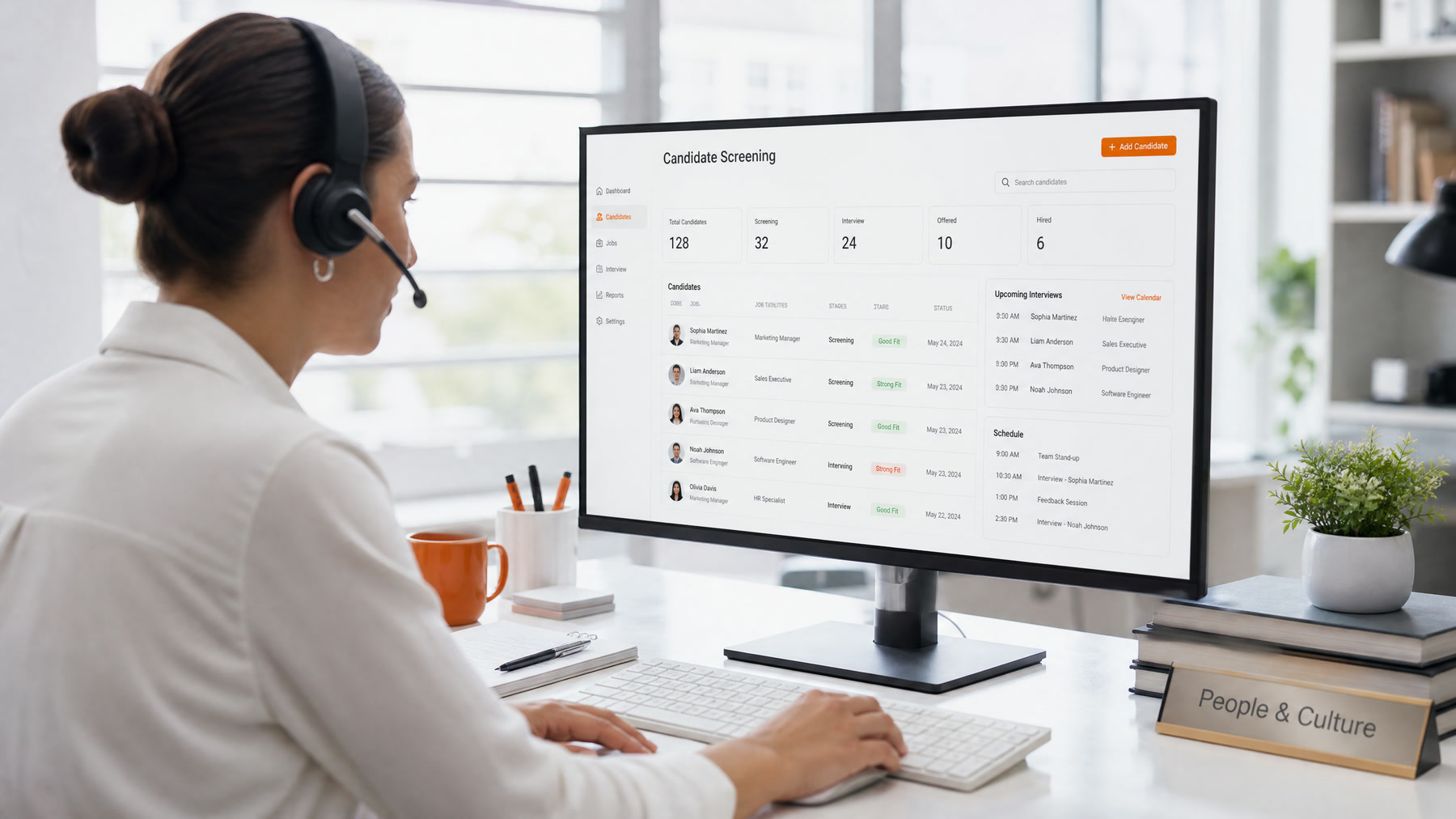
Why calls matter for recruitment agencies
Staffing runs on speed. Good candidates apply to several jobs at once, and for hourly and light industrial roles, the agency that calls first often fills the shift. Recruiters spend hours dialing applicants, leaving voicemails, and asking the same screening questions, while clients wait for submittals.
An AI voice agent calls new applicants back within minutes, asks your screening questions the same way every time, checks availability and shift preferences, and books qualified candidates with a recruiter. It also answers inbound calls from candidates and clients and logs everything in your ATS, while hiring decisions stay with your team.
Common call types
Automations
Benefits
What a call sounds like
An illustrative example of a typical call. Your receptionist follows your own rules, services, and wording.
What the AI receptionist asks
Urgent calls go straight to a person
A worker reporting an injury or a safety problem on a job site
The caller is told to call 911 if anyone is seriously hurt. The details go straight to your on-call manager, since workplace injuries need prompt reporting.
A client needing replacement workers for a shift today
Routed to the account manager immediately with the shift details.
A worker who cannot make a shift
Logged and sent to the recruiter and client contact so the shift can be covered.
Harassment or discrimination complaints
Transferred to a manager or HR contact, never handled by the AI.
Works with your software
We connect through each vendor's API, webhooks, or a workflow tool. What is possible depends on your plan and the vendor's API access, which we confirm before quoting.
What to get right
Implementation plan
Write screening questions for each role with your recruiters, removing anything not job-related.
Connect your ATS, calendars, and texting tools.
Set must-have rules and send borderline candidates to a person.
Pilot on one high-volume role, then review transcripts and fill rates.
AI receptionist or a live answering service?
An answering service can tell an applicant that a recruiter will call back. It cannot run a phone screen. An AI agent asks your screening questions, checks shift availability, and books the interview, while injury reports and complaints go directly to your staff.
A live answering service
- Operators answer from a script and take a message for you to return.
- Booking into your calendar is rare and usually costs extra.
- Callers can wait when operators are busy with other clients.
- Billed by the minute or by the call, so busy months cost more.
- Better for upset callers and one-off situations that need judgement.
An AI receptionist
- Answers from your own services, prices, service area, and rules.
- Books the appointment, sends the confirmation, and updates your records during the call.
- Answers every call at once, at any hour.
- A one-time build plus usage, quoted before work starts.
- Hands urgent or unusual calls to a person, with the details gathered so far.
More detail: AI receptionist vs answering service and the published prices of eight services.
What it costs
Focused automations such as missed-call recovery typically cost $2,000 to $5,000 to build. A production AI receptionist with booking, CRM updates, and call transfers typically costs $5,000 to $15,000, plus monthly usage for calls and texts. Every quote is fixed-scope and in US dollars. See pricing details.
FREE CALL-FLOW REVIEWRelated services
FAQs
Can AI screen candidates by phone?
Yes. It asks structured questions, records answers, and schedules qualified candidates with recruiters.
Can it update the ATS?
Yes, through your ATS's API or a workflow tool, depending on your plan and the vendor's API access.
Can it reject candidates automatically?
We recommend using AI to collect answers and flag missing requirements, and leaving final decisions to recruiters. Some cities and states also regulate automated hiring decisions.
Can it call our existing talent pool about open shifts?
Yes. With consent, it calls or texts past candidates about new roles, confirms availability, and updates their records.
Is AI phone screening legal?
Yes, when questions are job-related and you follow local rules on automated hiring tools, such as New York City's Local Law 144. We review the call flow with you before launch.
Can it screen candidates in Spanish?
Yes. English and Spanish screens are available, with the same questions in each language.
Related guides
AI Receptionist for Staffing and Recruiting Agencies: Candidate and Client Intake
VOICE AI COMPLIANCEAI Voice Calls and the TCPA: What the FCC's 2024 Ruling Means
AI GOVERNANCEHuman-in-the-Loop AI Automation: How to Keep Control
AI VOICE AGENTSInbound vs Outbound Voice AI Agents: What Is the Difference?
INDUSTRY AIBilingual AI Receptionist: Serving Spanish-Speaking Customers Without Hiring
Sources
General information, not legal advice.
- Prohibited Employment Policies/Practices (U.S. Equal Employment Opportunity Commission)
- Automated Employment Decision Tools: Frequently Asked Questions (NYC Department of Consumer and Worker Protection)